In this article
A statement contains several different kinds of numbers. Reading them as one total makes a normal difference look like an unexplained one.
Begin with the label and the period
Aramark’s public myPay FAQ describes access to current and past pay statements and tax forms. It does not provide this publication with a reader’s statement or prove that every account uses an identical layout. The field names below are common reading concepts, not a reconstruction of an Aramark screen.
First identify what the document calls its covered period and its payment or issue date. Then distinguish the column for that period from cumulative columns. A year-to-date amount answers a different question from a current-period amount. Do not subtract figures across those columns merely because both are labeled “earnings.”
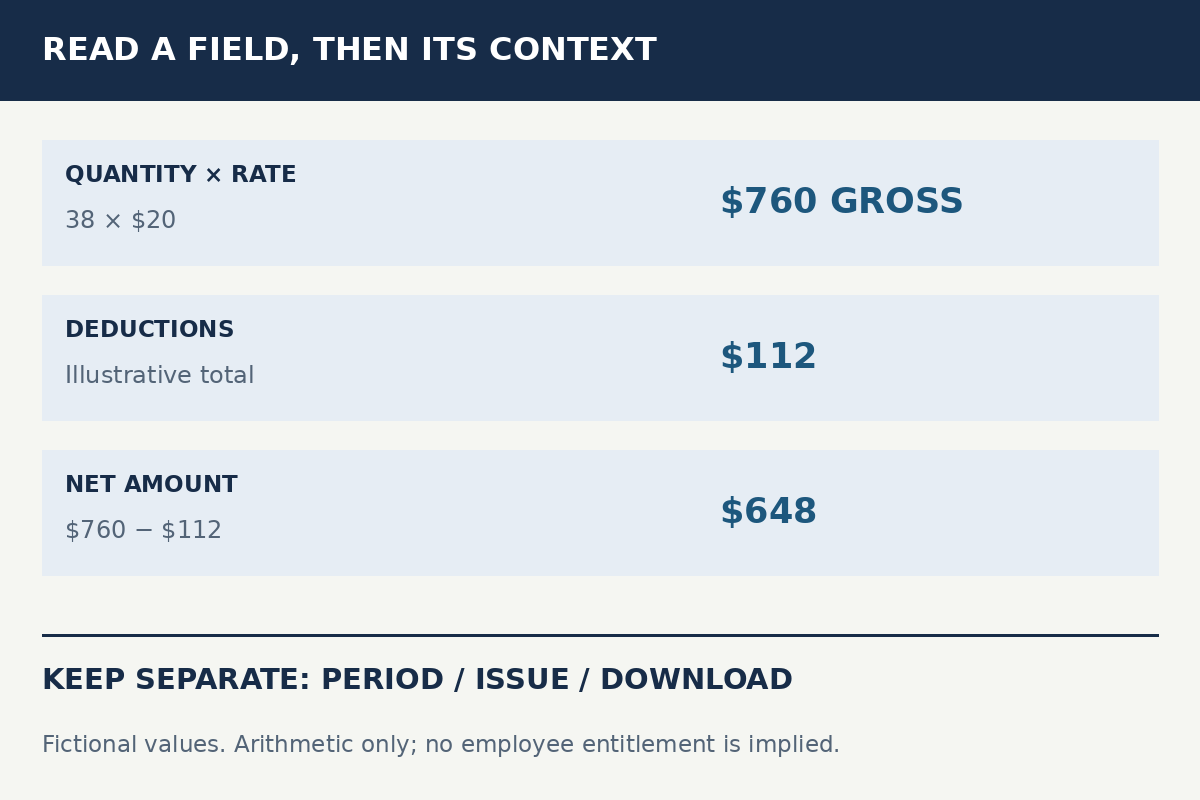
A small example with explicit assumptions
| Field | Fictional value | What it answers |
|---|---|---|
| Quantity | 38 units | Quantity assigned to this example line |
| Rate | $20 per unit | Multiplier for this example line |
| Gross earnings | $760 | 38 × $20 before the example deductions |
| Combined deductions | $112 | A fictional total, not a tax calculation |
| Net amount | $648 | $760 − $112 under these assumptions |
The example establishes arithmetic only. It says nothing about whether 38 is the correct quantity, $20 is the correct rate, a deduction is authorized or a legal pay rule applies. Those are separate questions requiring the actual record and appropriate employer or professional review. A calculation can be internally consistent while one of its inputs still needs correction.
Keep three comparisons separate
- Line arithmetic: do the stated quantity and rate reconcile to the line amount under the document’s rules?
- Statement arithmetic: do the earnings, deductions and other adjustments reconcile to the stated total? Do not assume all documents treat every adjustment identically.
- Underlying facts: does the quantity, rate or category match the relevant approved record? An arithmetic check cannot establish that fact.
If a statement includes several rates, reversals or additional payments, do not force it into the simple example. Read each line label and its sign. A negative line may be part of a correction, but its presence alone does not tell you why it was entered. Ask what the line means rather than assigning a cause from its appearance.
Make a discrepancy narrow enough to review
“The total is wrong” is less useful than “the quantity on this named line differs from the approved record for this period.” Keep the reference to the period, field and source. If you cannot identify the field, ask the employer contact to explain the label before calculating a difference.
Fictional comparison
A reader sees 38 on a statement and 40 on a weekly planning sheet. The planning sheet may describe scheduled work rather than the approved input used for pay. The next question is which record supplies the quantity, not whether the unexplained two-unit gap automatically proves underpayment. The reader can preserve the observation without deciding the answer.
Finish with a question, not a verdict
Record the field that needs explanation and the evidence you have. Keep actual statements and personal values in your employer’s approved channel. This website does not accept uploads or calculate a reader’s wages, taxes or entitlements. Continue with a correction-evidence note once the difference is specific. If two downloads disagree, first use the version comparison.
Evidence and limits
Official public sources checked October 16, 2026. Examples and practical reading methods are original editorial analysis. No employee account or authenticated workflow was tested.
- Aramark myPay frequently asked questions
Public description of payroll records and separate current/former employee access. No authenticated account, statement layout or individual payroll result was reviewed.